Multimodal communication during courtship in the house cricket Acheta domesticus
Principal Investigator at ZRC SAZU
Taina Conrad, PhD-
Original Title
Multimodal communication during courtship in the house cricket Acheta domesticus
Project Team
Simona Kralj Fišer, PhD-
Duration
1 May 2025–30 November 2026 -
Lead Partner
-
Project Leader
-
Financial Source
Alexander von Humboldt Stiftung

Partners
dr. Nataša Stritih Peljhan
Communication is an essential prerequisite to all animal interactions, making it not surprising that animal signals can become quite complex and are often multimodal (integrating multiple sensory channels). Traditionally, multimodal communication has been explained by the “redundant backup” and “multiple messages” hypotheses. However, recent studies suggest that signal meaning may emerge from the interaction between modalities, rather than from their additive effects.
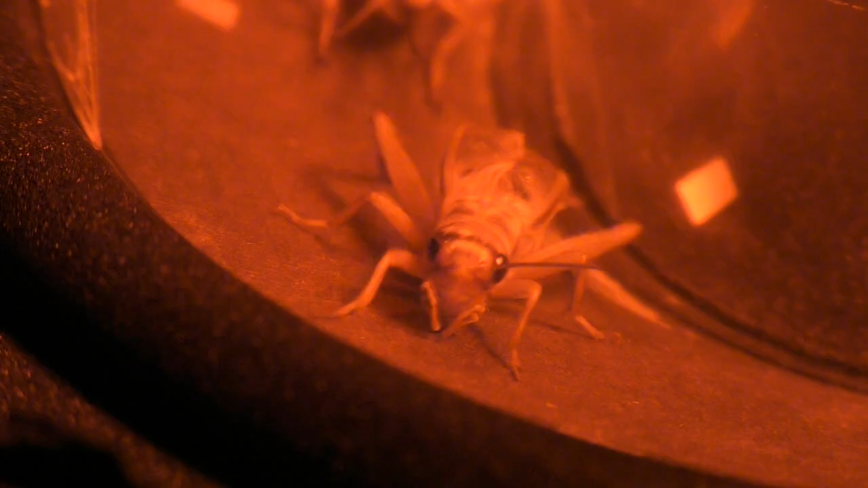
Acoustic and vibratory signals are particularly suited for such interactions, as both involve mechanical oscillations—airborne sound waves perceived by auditory organs and substrate-borne vibrations transmitted through solid or liquid boundaries and “felt”. Despite extensive research on cricket "songs," much less is known about their vibrational signals. The house cricket, Acheta domesticus, produces complex vibroacoustic courtship signals, including wing stridulation, body tremulation, and leg drumming, making it an ideal model species to study these interactions.
We aim to investigate the interplay between airborne and substrate-borne signals during courtship in A. domesticus, analyzing each modality independently and in combination. Using state-of-the-art laboratory and behavioral experiments, we will assess female preference for individual and combined signal components, their condition dependence, and the mechanistic constraints of signal production. This study will provide first insights into the complex interplay of airborne and substrate-borne signals in the context of sexual selection in our model species giving us a better understanding of how these signals work together, thereby providing us with a framework for other species.